There are no magic solutions, but a great deal can be done to surface problems before they turn into accusations and to design new ways of working together that increase role clarity and trust within the group.
Visual Team Coaching is an integral part of the Visual Psychology® Method, created by Federica Tabone, and is designed for teams that want to overcome internal resistance or identify more effective ways of organising their work.
As an Organisational Psychologist, I guide teams through a journey that combines dialogue, experiential activities and structured debriefing sessions.

The objective is not to improve people, but to improve what happens between people, taking into account both the context and the team’s objectives.
What Is Team Coaching?

Team Coaching is a group development process that increases awareness within the team, strengthens collaboration, creates clear operational agreements and reinforces individual accountability.
As an Organisational Psychologist, I observe the quality of the relationships that hold the group together, helping people build ways of working that are more effective, sustainable and aligned with the organisational context. Unlike One-to-One Coaching, which focuses on the individual, Team Coaching focuses on relationships: how people communicate, make decisions, manage conflict, sustain energy and unintentionally disperse it.
What Results Can Visual Team Coaching Deliver?

Many teams do not need to work harder. In fact, they often benefit more from optimising their efforts, increasing awareness of what is happening within the group and learning to recognise recurring dynamics with other departments.
Visual Team Coaching focuses on the identity of the team itself. To achieve this, we make visible the group’s dynamics, reaction patterns, formal and informal roles and cognitive styles.
By translating these elements into visual summaries, teams become better able to analyse problems, recognise cause-and-effect relationships, develop strategies and increase their influence within the organisation.
Through the Visual Psychology® Method, what emerges during the process is captured visually, making it easier to observe, build together and remember over time.
When Is Team Coaching Useful?

Team Coaching is particularly valuable when a group needs to regain direction, when responsibilities change, when new members join, when leadership changes or when increasing pressure begins to affect collaboration.
During the process, many teams discover that the challenges they were experiencing were not caused by individual behaviours but by a system that was no longer suited to the realities they were facing.
One of the main benefits of Visual Team Coaching is that teams regain a shared foundation from which to act, develop greater communication maturity and move beyond dysfunctional behaviours.
Let’s create clarity, rebuild trust, strengthen communication skills and discover the unique chemistry of the team you are leading.
Who Is Team Coaching For?

The most common situations identified by Team Leaders, Managers and HR Business Partners include:
- teams experiencing relational distance, misunderstandings or conflict that make direct conversations difficult
- teams needing to realign around strategy, collaboration practices and decision-making processes
- executive teams or groups of directors with significantly different leadership styles, values and assumptions that create operational inconsistencies across functions or departments
Team Coaching is particularly suitable for teams undergoing change, cross-functional groups building a shared identity and project teams composed of multiple generations, including Generation Alpha, Generation Z, Millennials, Generation X and Baby Boomers. Throughout my professional experience, I have also worked with international teams seeking greater mutual understanding through intercultural management approaches.
Frequently Asked Questions
How Does a Visual Team Coaching Programme Work?
The programme duration varies according to organisational needs and is typically structured across five half-day sessions.
Drawing on Systemic Psychology, the process begins with individual contributions, which are gradually woven into a broader narrative that expands the team’s understanding of itself.
The focus then shifts back from the group to the individual, with each participant leaving the programme with personal commitments aligned to their role.
The first phase develops perspective-taking, critical thinking and systems thinking in order to understand group dynamics more deeply.
The second phase focuses on solution generation through lateral thinking, paradoxical thinking and future-oriented reflection, enabling the team to create operational agreements and build new ways of working together.
Why Is It Called Visual Team Coaching?
Putting thoughts onto paper brings clarity and helps teams reach the heart of an issue more quickly.
During sessions, I visually synthesise the team’s reasoning, recurring challenges and shared meanings.
Visual facilitation is an integral part of the Visual Psychology® Method and is rooted in my experience as a Graphic Recorder.
Seeing how a team functions represented visually allows members to step back, interpret situations more effectively and develop stronger solutions.
Each session therefore generates new awareness that can be immediately applied in everyday work.
Why Does the Visual Approach Work So Well in Team Coaching?
Through direct experience, I have seen that experiential activities reveal significantly more information than dialogue alone.
I have observed this for more than twenty years as an Organisational Psychologist and Graphic Recorder, working with over 6,000 people across more than 100 organisations.
Practical activities stimulate the group because they activate lateral thinking through visual metaphors and strategic thinking through the collection of board games and experiential tools I use.
Whether delivered in person or online, every session alternates collective discussions, visual retrospectives, guided exercises and even board games, to bring group dynamics to the surface in a subtle and engaging way.
Debriefing acts as the punctuation that gives rhythm and depth to conversations, and it too is visually synthesised.
When teams can literally see their conversations on paper, it becomes easier to understand challenges, align perspectives and discuss issues more openly and constructively.
How Is the Visual Psychology® Method Applied in Team Coaching?
The Visual Psychology® Method integrates Organisational Psychology, group facilitation techniques and visual thinking.
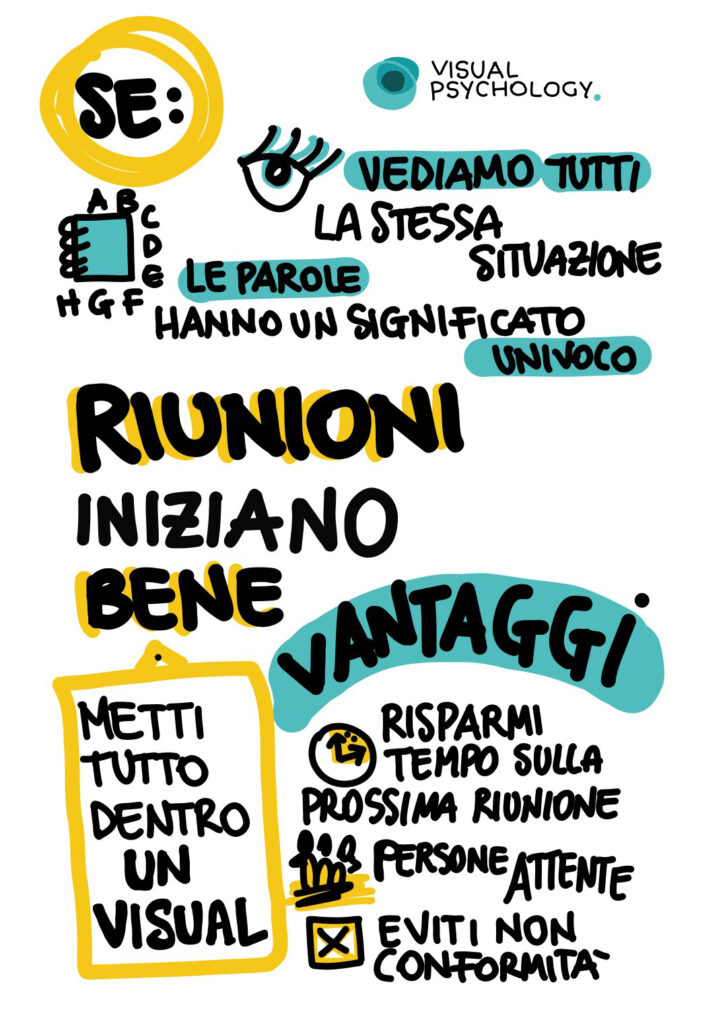
In Visual Team Coaching, we do not simply talk about problems. We observe them and represent them visually.
The visual dimension helps teams to:
- see processes rather than merely imagine them
- recognise recurring relational patterns
- clarify areas of agreement and disagreement
- remember what emerged during the programme
- create a shared language that endures over time
Each visual output becomes an identity map for the team: a practical tool that can continue to be used after the programme has ended.
Roles, dynamics, objectives, tensions and strengths all take shape through drawings that are observed and co-created by the entire team.
Media
What People Say About Me
Every story is different, but we all face many of the same challenges. In these reviews, you may read about experiences that resonate with your own and find a helpful perspective on how to deal with them.