Within workplace teams, priorities are not always clear and conflicts may recur, causing collaboration to lose effectiveness.
The issue rarely lies in people’s technical competencies. More often, it resides in the dynamics that develop between them.
Through the Visual Psychology® Method, I help organisations map and decode relationships and patterns of mutual influence.
Using facilitation and visual language, relational bottlenecks can be transformed into more fluid processes, improving team climate, collaboration and operational effectiveness.
Who Is Group Dynamics Analysis For?
People do not behave in the same way in every context.
Each group has its own unique chemistry and develops distinctive ways of communicating and making decisions over time.
For this reason, the work I design together with HR professionals and managers goes beyond individual behaviours and focuses on the relationships and processes that influence team effectiveness.
The goal is to build on the strengths already present within the group and create the conditions for more effective and constructive collaboration.
Group dynamics analysis is particularly valuable for:
- teams undergoing organisational change, such as mergers or restructuring;
- cross-functional teams requiring greater alignment between priorities and roles;
- project teams experiencing recurring conflicts;
- international or hybrid teams integrating different perspectives, cultures and working styles;
- project teams experiencing tension or execution bottlenecks;
- teams that struggle with ineffective or frustrating meetings.
What Are Group Dynamics?
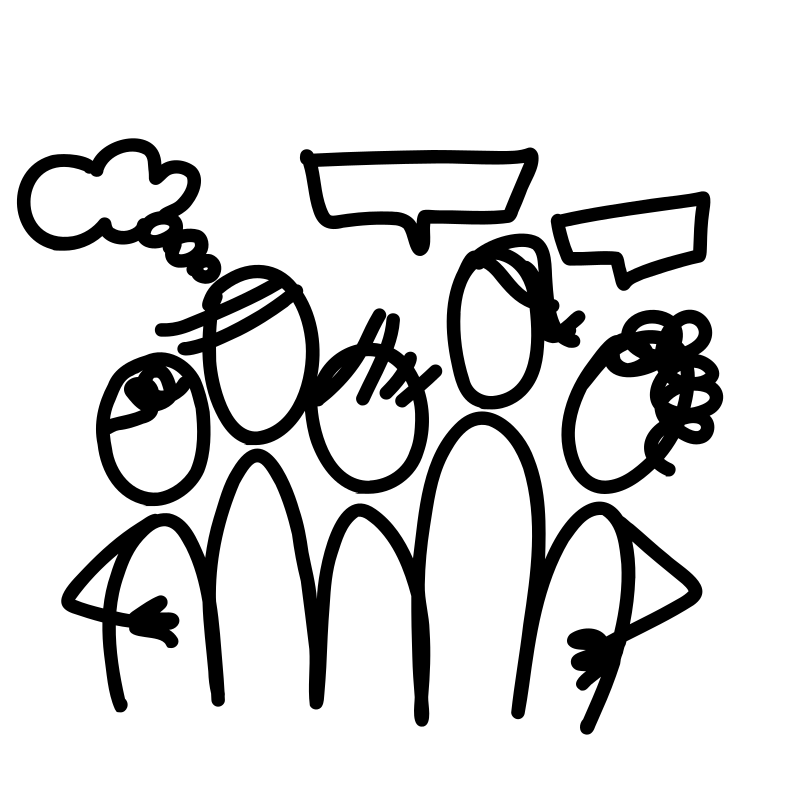
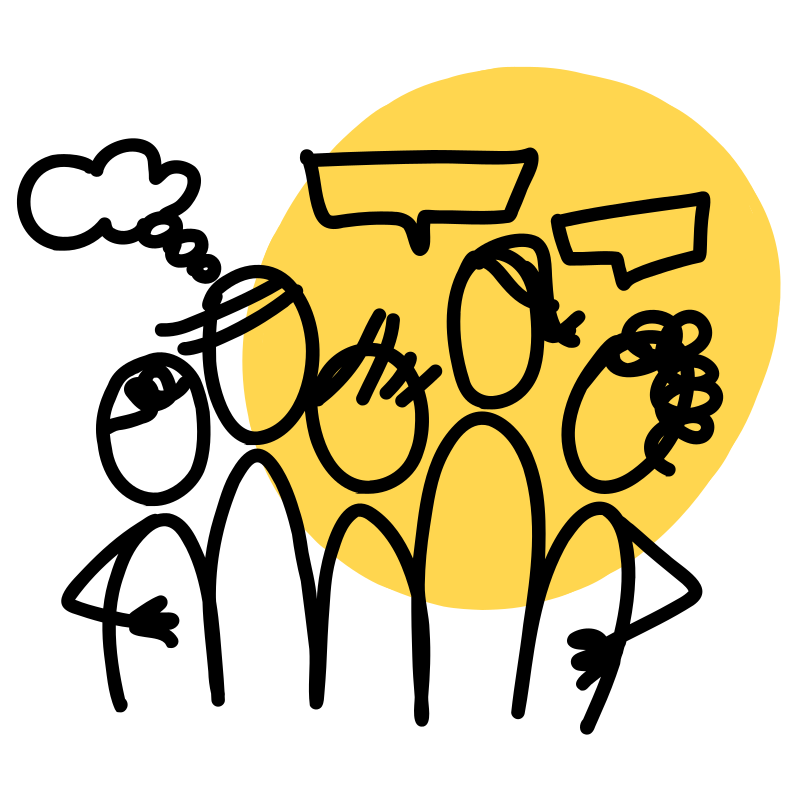
A group is a network of actions, interactions and feedback loops that generate qualities which do not exist within its individual parts when considered separately.
Drawing on the perspective of philosopher Edgar Morin, group dynamics can be understood as the living organisation of interactions between people, roles, contexts and unforeseen events, rather than simply the sum of individual behaviours (E. Morin, 1990, Introduction à la pensée complexe).
If we wanted to visualise group dynamics, we might imagine the weave of a fabric: patterns of interaction, feedback cycles, the relationship between order, disorder and organisation, the way context influences the group and the way the group, in turn, influences its context.
Understanding these dynamics means giving a name to what is happening and creating the foundations for conscious and sustainable change.
What Is Observed During a Group Dynamics Analysis?
Observation takes place within the group’s natural working environment while people are engaged in their normal activities, such as project meetings, feedback conversations between managers and team members, or quarterly review meetings. The analysis focuses on four key dimensions:
- 1. The Architecture of the Meeting
The organisational structure of the meeting is analysed, including logistics, time management, content management and the way these factors influence outcomes in terms of authentic communication and future planning capability.
- 2. Group Identity
This dimension explores:
· sense of belonging (ingroup/outgroup dynamics);
· symbolic boundaries with external groups;
· team cohesion;
· leadership patterns;
· alignment between people and roles;
· status asymmetries;
· the collective image the group holds of itself.
(Turner et al., 1994, Self and Collective: Cognition and Social Context) - 3. Connections Between People
This area focuses on:
· communication flows;
· alliances and distance;
· consensus and friction;
· empathy and polarisation;
· explicit and implicit rules governing the group. - 4. Team Energy
This dimension explores:
· self-organising strategies;
· patterns of emotional involvement;
· the sources of the group’s generative energy;
which can then inform future development initiatives.
The findings are translated into a detailed feedback report covering all four dimensions.
This analysis often becomes the foundation for targeted interventions, such as Team Coaching, One-to-One Coaching or modular learning programmes delivered through the Sketch.Mind format.
Before intervening, it is useful to understand what is actually happening within the group. Only then is it possible to improve both performance and relationships.
Why Is Analysing Group Dynamics So Valuable?

This type of intervention helps organisations identify early the dynamics that may be slowing collaboration, engagement, accountability and decision-making quality.
It is particularly valuable during:
· organisational change;
· onboarding of new managers;
· restructuring initiatives;
· team mergers;
· digital transformation projects;
· initiatives requiring strong cross-functional collaboration.
Often, team members sense that something is not working, yet everyone has a different explanation as to why.
Understanding what is really happening benefits greatly from an external perspective.
Throughout more than twenty years as an Organisational Psychologist, I have worked with over 6,000 people, observing group dynamics directly within organisations and delivering more than 160 coaching programmes for managers.
This experience allows me to help organisations:
- identify where teams become stuck and why;
- clarify responsibilities and mutual expectations;
- understand how decisions are made — or avoided;
- manage or prevent intra-team and interdepartmental conflict;
- improve communication and delegation practices;
- rebuild trust by creating new shared meanings and encouraging more authentic communication.
Transforming a group of individuals into a team requires more than good intentions and occasional effort.
Media
What People Say About Me
Every story is different, but we all face many of the same challenges. In these reviews, you may read about experiences that resonate with your own and find a helpful perspective on how to deal with them.