
HR professionals and C-Level leaders invest in managers who can read the context, define priorities, support the growth of their people, facilitate coordination across functions and address difficult conversations rather than postponing or avoiding them.
By visualising each line of reasoning with pen and paper, coachees develop greater self-awareness, explore new perspectives and plan concrete next steps.
Visual Coaching is an integral part of the Visual Psychology® Method, created by Federica Tabone, Organisational Psychologist.

Would you like to design a Visual Coaching programme for a team or manager within your organisation?
Get in touch and let’s build the most suitable journey for your context together.

What Is Visual Coaching?
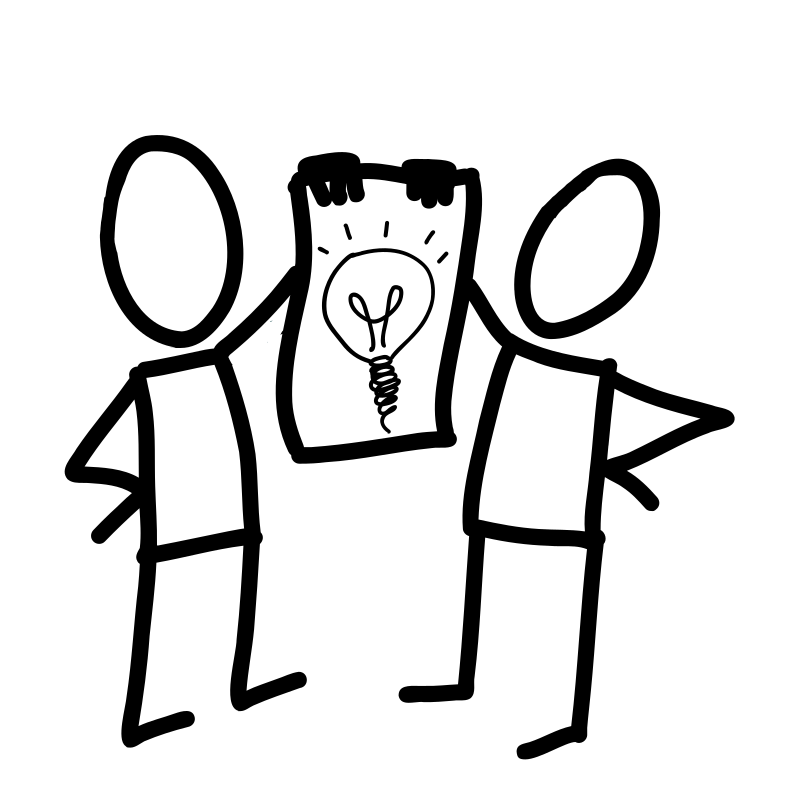
Imagine being able to keep all your ideas and reflections within reach, as if they were cards on which thoughts become ink.
In Visual Coaching, dialogue takes shape in real time. My coachees can see their own story because I draw it for them.
Even in online sessions, we can include hands-on activities such as origami-inspired shapes, which adds a three-dimensional dimension to thinking and makes insights more memorable.
How Does Visual Coaching Work?

The coachee, or the group participating in team coaching, shares their experience as if it were a film that is paused at a particular moment.
Together, we explore those frames and give them shape through drawing. This allows us to develop new interpretations of reality and anticipate future scenarios.
As an Organisational Psychologist, I integrate different psychological and scientific approaches to understand and transform the way we think, act and relate to others.
The main theoretical foundations include:
- Cognitive Behavioural Psychology, which connects thinking styles to individual reactions and helps reveal limiting beliefs
- Systemic Psychology, which shifts the focus from the individual to the network of relationships and mutual influences
- Strategic Problem Solving, which uses paradoxes and lateral thinking to identify new possibilities for action
- Naturalistic Intelligence, which explores how nature solves complex challenges related to efficiency, adaptation, change and innovation
Visual Coaching Programmes
The approach consists of three pathways designed for different needs, while sharing the same objective: making goals, relationships, challenges and opportunities for growth visible. The methodology may include:
- visual summaries created in real time to highlight patterns of reasoning
- metaphorical icons that support long-term memory
- organisational sociograms to analyse relationship systems
- metaphorical cards that stimulate lateral thinking and problem solving
- Origami-inspired shapes that give three-dimensional form to theories and concepts.

One to One Coaching
An individual programme designed for Managers and Team Leaders who wish to evolve their leadership style. Beyond technical expertise, many professionals recognise the need to strengthen soft skills related to team management.
Following feedback discussions or performance reviews, development areas often emerge around decision-making, delegation, strategic thinking, communication and interpersonal effectiveness.
Visual Coaching helps people observe themselves from an external perspective, increasing awareness and developing a clearer understanding of both their own behaviours and the dynamics within their teams. Together, we transform reflection into more effective action.

Team Coaching
A programme designed for teams, organisational units and groups of managers seeking to improve collaboration, communication and operational effectiveness.
Through visual tools, teams can better understand their own dynamics, make automatic patterns and resistance visible, compare perspectives and build a more shared understanding of their working context.

Expat Coaching
A programme designed to support professional and cultural transitions, particularly when change affects role, context, identity and relationships.
Visual approaches help clarify what is happening, give shape to resources and challenges, identify expectations and areas requiring attention, and support adaptation with greater awareness.
When Is Visual Coaching Useful?

Visual Coaching is particularly valuable when there is a need to:
- bring clarity to complex situations
- reframe professional and organisational dynamics
- navigate periods of change
- make goals, opportunities and actions more tangible
- work with individuals and teams in a more engaging and memorable way
The methodology can be applied in both individual and group programmes, either in person or online.
What Makes Visual Coaching Different?

In Visual Coaching, conversations do not disappear when the session ends. They remain visible.
This allows ideas and connections to stay within sight, makes thoughts tangible, supports understanding and memory, and encourages deeper reflection on what emerges during the process.
The journey helps people develop greater self-awareness, identify ways forward and experiment with new approaches that are more aligned with both their context and their objectives.
Visual tools do not simply add a decorative element to coaching. They create a space in which seeing more clearly enables better choices.
This methodology is also grounded in extensive experience: I have delivered more than 150 one-to-one Visual Coaching programmes for managers and worked with over 6,000 people through training, blended learning and team coaching initiatives.

Frequently Asked Questions
What is Visual Coaching?
Visual Coaching is a development process that combines coaching with visual facilitation.
During sessions, ideas, dynamics and objectives are transformed into visual representations that help people better understand what is happening and work on it in a more practical way.
Is Visual Coaching only for individuals?
No.
It can be delivered both as an individual coaching programme and as a team-based intervention. Both One-to-One Visual Coaching and Visual Team Coaching are available.
Can it be delivered online?
Yes.
Individual coaching can be delivered entirely online.
Which tools do you use during the programme?
Depending on the context, the programme may include real-time visual summaries, graphic representations, organisational sociograms, Icon Cards, LEGO®-based activities, origami-like shapes and other tools designed to make thoughts, connections and dynamics visible. a
Who can benefit from Visual Coaching?
Visual Coaching is valuable for professionals, managers, teams and organisations that want to gain clarity, reframe dynamics, navigate change and work in a more visible and practical way on objectives, relationships and development.
How does this differ from traditional coaching?
In Visual Coaching, the process does not rely solely on dialogue.
Words, connections and dynamics take visual form and remain observable over time. This makes the work clearer, more memorable and more tangible, supporting deeper reflection and more effective action.
Media
What People Say About Me
Every story is different, but we all face many of the same challenges. In these reviews, you may read about experiences that resonate with your own and find a helpful perspective on how to deal with them.